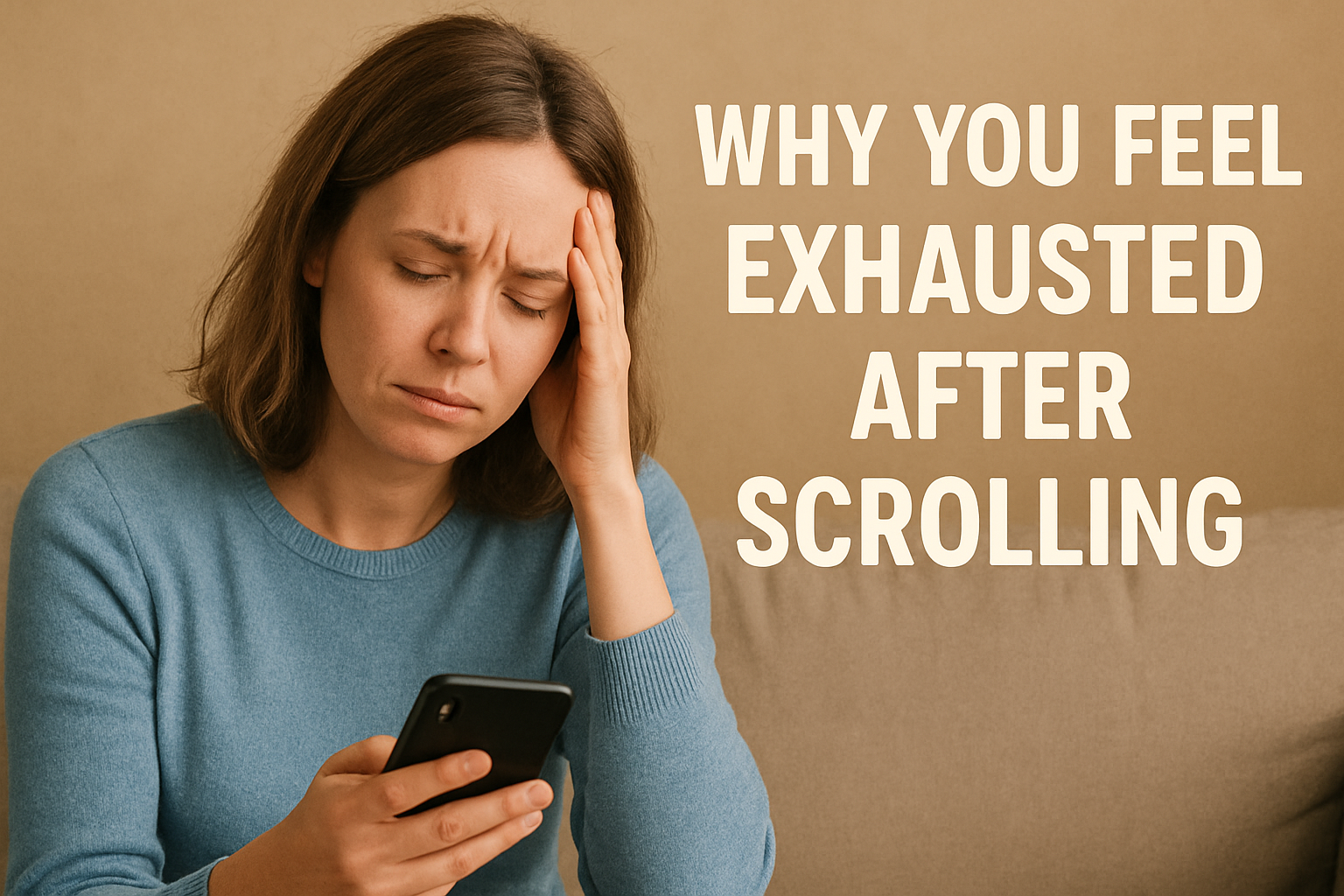
Why You Feel Exhausted After Scrolling isn’t just in your head — it’s a real psychological effect that millions experience every day. You open your phone “for one quick check.” An hour later, you’re empty — not physically, but somehow hollow and jittery, with a fuzzy head and less patience than before.
Sound familiar?
You’re not lazy or weak. You’re wired into a system designed to keep your attention — a system powered by algorithms, dopamine loops, and carefully timed notifications. Over time, it chips away at your mental energy, focus, and emotional balance.
According to a Statista report, the average person now spends more than 2 hours and 23 minutes per day scrolling through social media. And while you might think of scrolling as “downtime,” your brain is doing the opposite — constantly switching between emotions, micro-decisions, and social comparisons. That’s why after even a few minutes of “just checking,” you feel more drained than before you started.
Psychologists call this phenomenon “digital fatigue” — a hidden form of burnout caused by endless mental stimulation and emotional overstretching.
In this article, we’ll unpack the science and psychology behind why scrolling exhausts you, explore how different digital habits drain specific parts of your brain, and share practical, research-backed steps you can take to restore balance to your tech life.
The short answer: it’s not just screen time — it’s attention, reward, and emotional load
Two main forces combine to make scrolling so draining:
- The attention economy — platforms are engineered to capture and flick your attention repeatedly. That rapid switching makes your brain work harder to reorient and decide what’s important. Think of it as constant small cognitive tasks piling up. Harvard Business Review and other researchers have documented how these interruptions sap productivity and mental energy.
- Reward & arousal cycles — likes, variable-length videos, and unpredictable content give your brain quick dopamine hits. Those hits feel good, but they also set up a craving loop: you keep chasing the next small reward, and that loop burns self-control fuel. Forbes and psychology write-ups describe how doomscrolling and addictive feed design take advantage of these loops.
Together, these make scrolling deceptively effortful — it’s not heavy lifting, but it’s persistent micro-work for your attention system.
What “exhausted” actually means here (and why it’s different from sleepiness)
When we say exhausted after scrolling, we’re talking about several overlapping types of fatigue:
- Cognitive fatigue — your ability to concentrate drops, working memory gets fuzzy, problem-solving slows. For example, one study found that participants who used significant night screen exposure had lower cognitive scores in attention, calculation, and working memory.
- Emotional exhaustion — constant doom-scrolling or negative social comparison leaves you more anxious, sad, or irritated even after the device is off. A report on screen time and mental health shows long hours on digital devices link to higher rates of depression and anxiety.
- Decision fatigue / self-control drain — every swipe, click, tap is a tiny decision. Over a long session it adds up. Research shows remote work with heavy screen loads and blurred boundaries led to measurable mental fatigue: 31% of variation in mental fatigue explained by difficulty separating work from personal life.
- Recovery disruption — late night screens, content that’s emotionally high or layered, and blue-light exposure mess with sleep and circadian rhythms. One study found adolescents with ≥ 9 hours screen time were 60% more likely to report bad sleep than those with under 2 hours.
These types often overlap. You may feel jittery and dulled at the same time: that’s the hallmark of attention and emotional system overload.
How common is the behaviour? (Numbers that matter)
If you think everyone does this, you’re right.
According to a recent report, among teenagers ages 12-17 in the U.S., 50.4% reported 4 hours or more of daily screen time (excluding schoolwork) between July 2021 and December 2023. Even more telling: among that group, those with 4+ hours had 27.1% reporting anxiety symptoms and 25.9% reporting depression symptoms in the past 2 weeks — compared to 12.3% and 9.5% respectively among those with less than 4 hours.
And in a global consumer-survey, 6 in 10 people who feel they spend too much time on screens worry about their physical or emotional well-being, while only about 2 in 10 of those who don’t struggle with screen time feel the same worry.
So yes — the behaviour is widespread, and the correlations with fatigue, mood, and well-being are real.
The hidden psychology: five mechanisms that steal your energy
1. Variable rewards (the slot-machine effect)
Scrolling feeds don’t just show you things — they show you unpredictable things. Sometimes you get something delightful or interesting, sometimes nothing. That unpredictability keeps you tapping. Psychologists say this mechanism underlies compulsive checking and digital loops.
2. Continuous partial attention (switching cost)
Each time you switch from a post to a video, skip to the next tab, close and open another app, your brain is paying a cost. Studies show attention switching and multitasking degrade focus, raise fatigue.
3. Emotional contagion & negativity bias
Newsfeeds often favour the dramatic or negative. Our brains are wired to notice threats. So when you scroll past upsetting headlines, comparison posts, or anxiety-provoking content, you pick up emotional residue. That residue weighs on you long after you close the app.
4. Social comparison and self-esteem hits
Scrolling is rarely neutral: you scroll through highlight reels of others’ lives. Every like, every filtered image, every “look at this perfect life” post chips away at your self-esteem and stokes comparison. Studies link heavy social media use to lower self-esteem and greater loneliness.
5. Sleep and circadian disruption
Late-night screen use messes with the body clock. One study found even young adults exposed to high screen time at night scored worse on “information speed, working memory, attention” domains. Also, light-at-night and mental arousal delay melatonin, reduce sleep quality and quantity.
Each of these mechanisms is enough by itself to sap mental energy; together they create a perfect storm.
Why “time limits” alone don’t always work
You might set a 30-minute cap and still feel drained. Why? Because it’s not just about the minutes. It’s about what you’re doing during those minutes, how scattered your attention is, the emotional load, the timing, what follows. A meta-analysis concluded screen time is prospectively associated with depressive symptoms, but effect sizes were small — meaning context and content matter a lot.
In other words: 30 minutes of passive doomscolling may be more draining than 60 minutes of intentional learning or reading. So it’s not enough to just count minutes — the pattern matters.
Practical fixes that actually help
Here are simple, realistic steps you can start now:
- Create a frictioned routine. Move tempting apps off your main home screen. Hide them in a folder or behind a second page. Make the habit less automatic. Research on digital behaviour change shows “away-from-screen” breaks (physical activity) outperform screen-based “breaks.”
- Swap the loop, don’t just cut time. When you catch yourself about to scroll aimlessly, replace the behaviour: five minutes of stretching, one page of a book, a short walk. You’re giving your brain a different reward pattern.
- Batch and schedule social checks. Rather than having alerts and feed access all day, decide to check social/news at certain times (e.g., 11:30 am, 7 pm). Outside those windows: no feed.
- Design a pre-sleep buffer. Stop feed browsing 60 minutes before bed. Charge your phone outside the bedroom. The research supports the link between night screen use and sleep troubles.
- Curate your feed aggressively. Unfollow accounts that make you feel drained, anxious or inadequate. Follow ones that inspire, teach, or calm you. Emotional load matters.
- Use tech to fight tech—but wisely. Use app timers, focus modes, one-screen-at-a-time rules. But remember: tools help most when combined with intention.
- Micro-breaks for attention recovery. After every 30-40 minutes of focused work or screen use, take a 5-minute break away from screens. Studies on attention show performance drops without breaks.
- Check how you feel, not just how long you scroll. The research shows it’s not just minutes but the effect on sleep, mood, relationships, focus that matters.
When it might be bigger than you think
If you’re feeling chronically drained, timing still off, mood skewed, sleep poor, and you can’t stop the scrolling — then you might be in what researchers describe as digital-burnout territory.
A study of remote workers found 78% reported 9 hours or more of screen time per day and that blurred boundaries explained ~31% of variation in mental fatigue.
Among adolescents, heavy screen time (4+ hours) is statistically linked with higher odds of anxiety (aOR ~1.45) and depression (aOR ~1.65) when mediated by sleep and physical activity.
If the behaviour is interfering with sleep, mood, work, or relationships — consider deeper action: digital detox, seeking guidance, lowering device availability.
Quick checklist: 7 things to try today
- Move social apps off your home screen.
- Unfollow or mute 20 accounts that trigger negative emotion.
- Set two “social feed windows” in your day and stick to them.
- Use your screen time stats/limits to actually watch what you do—not just how much you use.
- Charge your phone outside your bedroom; no scroll in bed.
- After every 30 minutes of screen time, get up, stretch, look away for 2 minutes.
- Reflect at night: How did I feel after scrolling? If drained, tweak the habit.
Final thought
So, if you’ve been wondering why you feel exhausted after scrolling, the answer lies in how your brain responds to constant stimulation. Every swipe keeps your mind alert but never satisfied, leaving your attention fragmented and your energy depleted.
The truth is, your phone isn’t the enemy — imbalance is. By setting digital boundaries, taking mindful breaks, and re-training your focus, you can enjoy technology without letting it consume your mental health.
Remember: your energy is one of your most valuable currencies in the digital age. Spend it wisely — not endlessly scrolling.
FAQs
Q: Is any screen time good or is all of it draining?
A: Not all screen time is equal. Intentional use (reading a long-form article, educational content, video call to a friend) tends to have different effects than passive infinite scrolling or feeding doom content. The drain comes more from how and when you’re using the screen than the mere fact of using it. For example, a study reducing screen time to ≤ 2 hours/day for three weeks showed improvements in sleep quality, well-being, stress and depressive symptoms.
Q: I only scroll for 10-15 minutes — how can that be exhausting?
A: Because the exhaustion may come from attention switching, emotional load, or sleep disruption rather than raw time. Even short sessions of unpredictable reward or emotional content can trigger fatigue. Also, if you’re scrolling right before bed or during long work sessions without break, the effect is amplified.
Q: Does this apply only to teens and heavy users?
A: No. While many studies focus on adolescents, the mechanisms apply to adults too. For example, research on adults aged 18–25 found that heavy screen time was linked to cortical thinning and poorer cognitive functions.
Q: What about work screen time? I have to be on device for hours.
A: Good question. Work screen time comes with its own fatigue dynamics: attention switching, decision fatigue, blurred boundaries between work and rest. A study found that remote workers averaging 9 + hours of screen time reported higher physical and mental fatigue, especially when boundaries were weak. So even necessary screen time can be managed better with breaks, boundaries and intentional transitions.
Q: Can reducing screen time really improve my mood and focus?
A: Yes — there’s growing evidence. For instance, the three-week screen-time reduction study (students reduced to ≤ 2 hours/day) saw small to medium effect sizes on depressive symptoms, sleep quality, stress and well-being. While it’s not a silver bullet, it shows change is possible and measurable.
🧠 Further Reading: The Psychology of Tech-Life Balance
Want to learn more about digital well-being and the psychology behind screen fatigue? Explore these expert resources from trusted organizations.
- Forbes – Stressed, Scrolling, And Stuck? Here’s What To Do About It
- Harvard Health – Why We Can’t Stop Scrolling
- American Psychological Association – Digital Stress and Mental Health
- Statista – Global Social Media Usage Time (2025)
- Pew Research Center – Teens, Social Media, and Technology 2024
- World Health Organization – Screen Time and Wellbeing Report
- MIT Sloan Management Review – The Cost of Always Being Connected
- The Guardian – The Endless Scroll: How Technology Keeps Us Hooked
- NIH – The Neurological Effects of Excessive Screen Time
- Psychology Today – The Dopamine Loop Behind Your Social Media Addiction