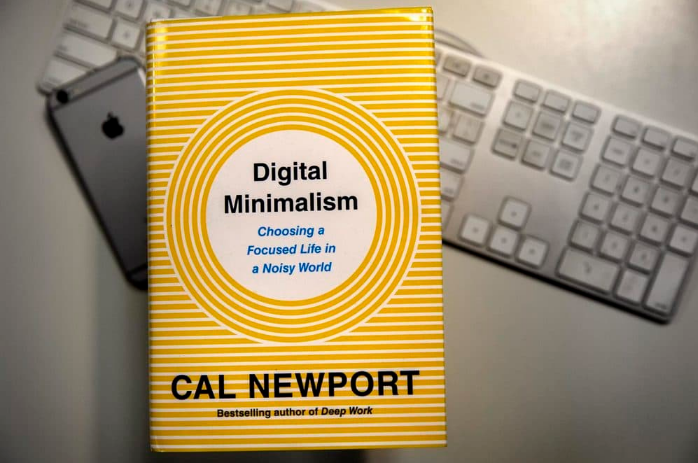
Digital Minimalism by Cal Newport — Why Haven’t You Read It Yet? Here’s What You’re Missing.
You’ve probably heard someone mention it — Digital Minimalism by Cal Newport. Maybe it’s been sitting in your online cart for months or collecting digital dust in your Kindle library. But here’s the question: why haven’t you read Digital Minimalism by Cal Newport yet?
If you’ve ever felt mentally fried after a day of “just checking” messages or scrolling through endless updates, this book is basically a wake-up call. It’s not about deleting every app or running off to the woods. It’s about learning how to use tech intentionally so it stops draining your time, focus, and peace of mind.
You’re not just tired. You’re stuck in a pattern of attention hijacked by apps, notifications, and endless scrolls. That’s exactly the world Cal Newport digs into in Digital Minimalism. He argues that in our hyper-connected age, the real question isn’t “which apps should I add?” but “what value am I trading my attention for?”
If you’ve yet to pick up this book, here’s why it matters — especially if you work remotely, live in Nigeria (or anywhere), and want tech to serve you instead of draining you.
1. A Philosophy, Not a Fad
Digital minimalism isn’t just a trendy hashtag — it’s a full-blown philosophy of tech use. Newport defines it as:
“A philosophy of technology use in which you focus your online time on a small number of carefully selected and optimized activities that strongly support things you value, and then happily miss out on everything else.” Superhuman Blog
The key: value over volume. Most of us assume more apps, more connectivity, more features = better. But Newport flips that: more can cost more — in attention, clarity, focus, and energy. Studies show that digital clutter increases cognitive load and reduces performance.
2. The Hidden Cost of Tech Overload
Newport uses the idea of “clutter is costly” to explain how even seemingly small digital habits accumulate into major drains.
Think about this: every time you open an unnecessary app, check a notification, or flick through social media while you should be working — you’re borrowing attentional energy you’ll never get back. Over time, this builds up, especially in remote work setups where home, work and leisure blur together.
3. The 30-Day “Digital Declutter”
One of the most actionable parts of the book is Newport’s Digital Declutter process:
- Choose your “optional technologies” (apps, platforms, services you could live without).
- Take a focused break from them (30 days).
- After the break, reintroduce only what truly supports your values — with clear rules around how you’ll use it.
For remote workers, this is gold. Imagine reclaiming one hour a day previously lost to distracted scrolling and instead funneling it into your career, your creativity, or even your rest. That’s not just productivity — that’s freedom.
4. Intentional Tech Use = Better Focus
If your job involves writing, coding, designing, teaching, managing, or creating — you already know focus is your superpower. Newport argues that technology should enhance your focus, not fragment it. He stresses “optimization is important” and “intentionality is satisfying.”
That means:
- Choose tools that serve you, not distract you.
- Set clear rules for when and how you use them.
- Replace passive tech consumption with meaningful activities (reading, deep work, conversation, skill-building).
5. Relevance for You (in Nigeria and Beyond)
Working remotely in Nigeria (or any global location) often means juggling time zones, connectivity issues, home distractions, and digital noise. The principles of Digital Minimalism help you:
- Create sharper boundaries between work and non-work.
- Focus your attention on the high-impact tasks (skills, clients, growth).
- Use tech as a tool for freedom — not a trap for your attention.
Whether it’s avoiding the “always-on” fatigue, preventing app addiction, or building a mindful work rhythm — this book offers a blueprint.
6. Core Takeaways You Can Use Today
- Audit your digital tools: List your apps, subscriptions, notifications. Ask: Does this support something I deeply value?
- Schedule your screen-time: Treat optional tech like a budget — allocate it.
- Plan analogue activities: Replace one “scroll” slot per day with non-digital leisure (walk, read, hobby).
- Design rules for tech use: E.g., “No social media before 10am,” “Check email in 30-minute blocks,” or “Use app X for 20 minutes max.”
- Reflect weekly: How did your attention feel? More focused? More scattered? Adjust.
7. Critiques & What It’s Not About
Some critics say digital minimalism sounds elitist (not everyone can “opt-out” of tech easily). But Newport clarifies: this isn’t about rejecting tech altogether — it’s about choosing tech rather than being chosen by it.
Also: don’t expect overnight transformation. The book is a mindset shift, not just a hacks list. It asks you to dig into your values and build intentional habits.
Final Thought
If you’ve yet to read Digital Minimalism, you’re missing more than a book — you’re missing a mindset. A mindset that says: “My attention is precious. My time is finite. My tools should serve me — not the other way around.”
Pick it up. Read it. Then ask: Which tech serves my values? Which drains them?