Strict blocking tools can feel appealing when distractions consistently derail work, but they also introduce trade-offs that are easy to underestimate. In modern remote work environments—where laptops double as offices, smartphones act as both tools and temptations, and attention is fragmented across platforms—extreme productivity measures can shape not just output, but mental well-being.
The StayFocusd Nuclear Option represents one of the strictest forms of browser control available, and it should be understood carefully before being used.
For a deeper breakdown of how StayFocusd works beyond extreme modes, including safety considerations, permissions, and everyday use cases, see the full StayFocusd review for a balanced look at whether it fits sustainable focus habits.
Table of Contents
What the StayFocusd Nuclear Option Is
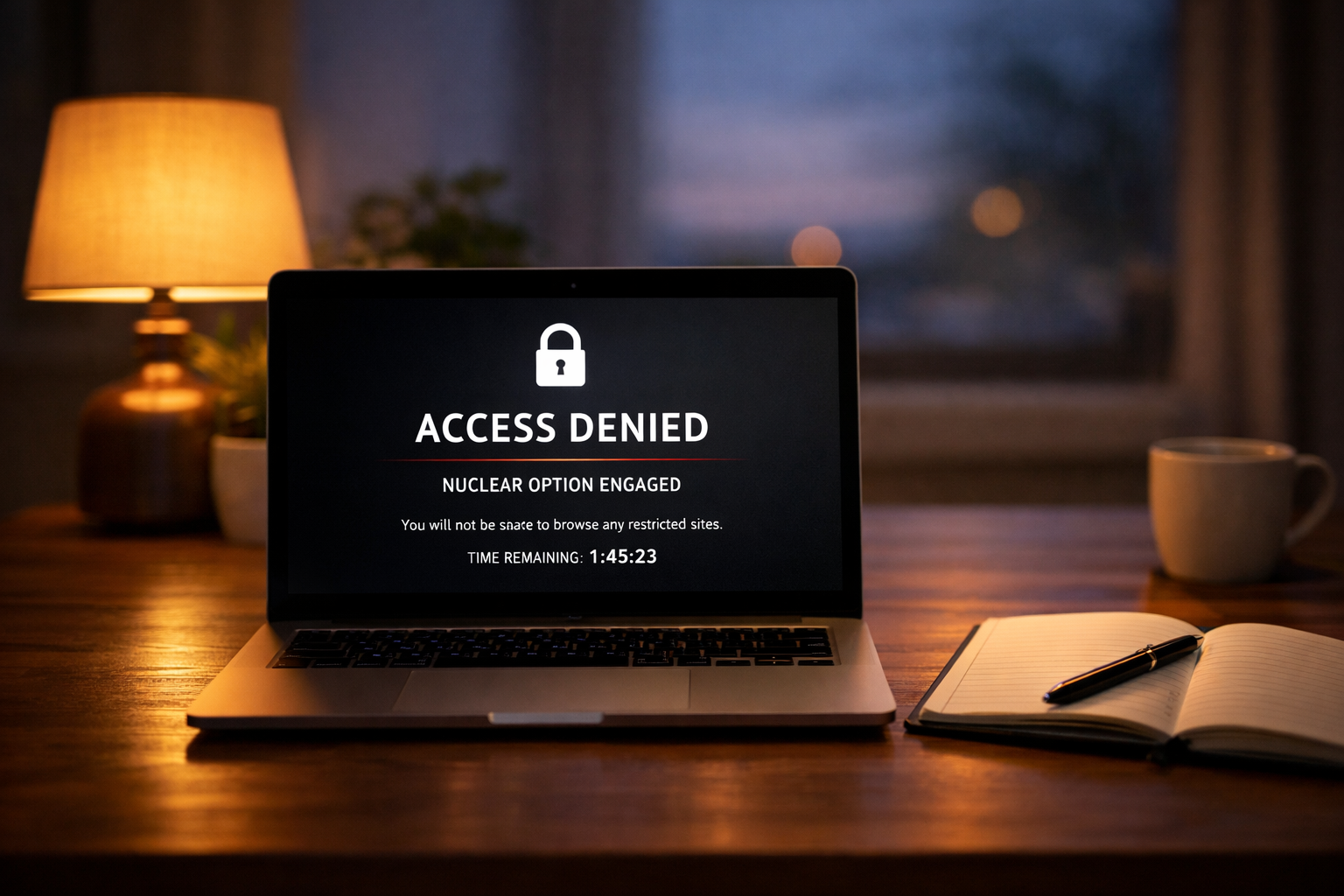
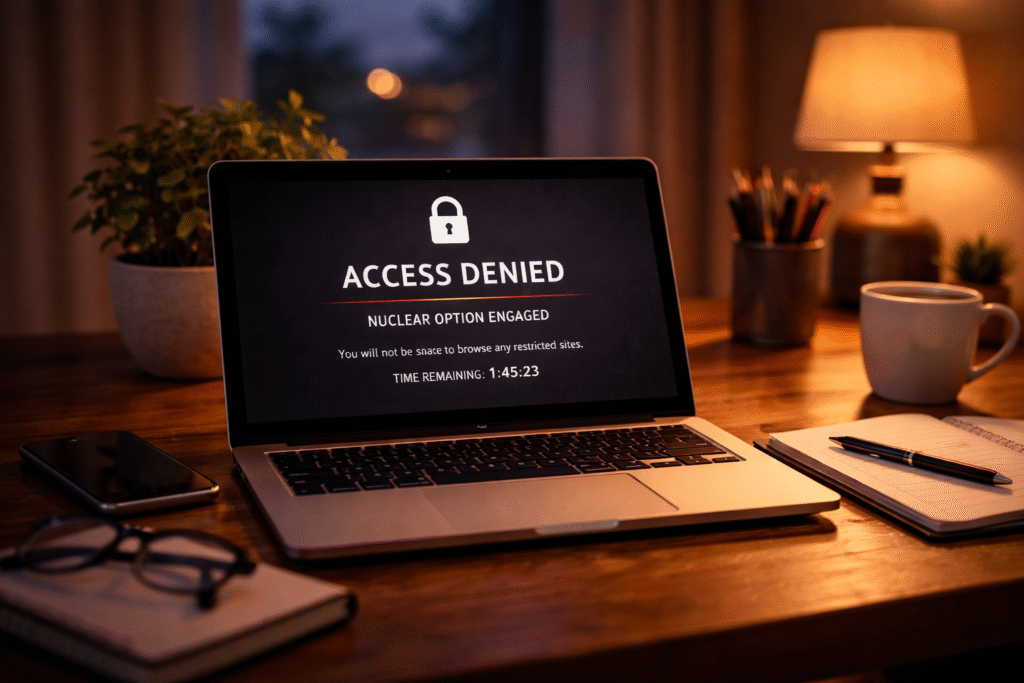
The StayFocusd Nuclear Option is a hard-lock feature that enforces complete browsing restrictions for a set period of time. Unlike standard blocking rules that allow adjustments, overrides, or gradual limits, this mode removes the ability to change settings, pause restrictions, or uninstall the extension until the countdown finishes.
Once activated, access to blocked websites, configuration panels, and even workaround methods is effectively sealed. The browser becomes a controlled environment focused solely on permitted tasks. This design is intentional and reflects the philosophy behind the feature: eliminate choice entirely to prevent distraction-driven decisions.
In real-world use, this feels less like a reminder and more like a system-level lock. The experience is immediate and binary. Either the block is active, or it isn’t. There is no negotiation with the tool once the timer starts.
How It Differs from Regular StayFocusd Blocking
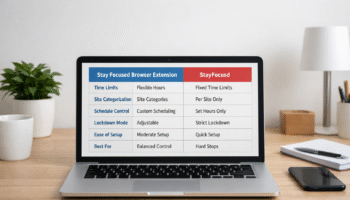
Standard StayFocusd features rely on behavioral nudges. They allow daily time limits, scheduled blocks, and customizable rules that adapt over time. These tools are designed to encourage awareness and gradual habit change.
The Nuclear Option removes that flexibility. Instead of reinforcing limits, it enforces them absolutely. There are no grace periods, no quick exceptions, and no second chances during the active window. This sharp distinction is what makes the feature effective for some users and overwhelming for others.
Why People Use Extreme Restrictions
Extreme productivity tools are rarely adopted casually. They are often activated during periods of high pressure, repeated distraction cycles, or frustration with softer interventions that no longer seem effective.
In remote and hybrid work settings, distractions are not occasional interruptions but persistent background noise. Social feeds, news tabs, messaging apps, and entertainment platforms coexist in the same browser used for work. Over time, this constant availability can erode focus and increase cognitive fatigue.
The Appeal of Removing Choice
One reason the stayfocusd nuclear option feels attractive is its ability to eliminate decision fatigue. When access is fully blocked, there is no internal debate about whether to check a site “just for a minute.” The decision is already made by the system.
This can create a sense of relief. Mental energy that would otherwise be spent resisting temptation is redirected toward the task at hand. For short, high-stakes work sessions, this structure can feel stabilizing.
However, the relief often comes from suppression rather than skill-building. The underlying habits and triggers that lead to distraction remain unchanged.
Modern Work Patterns That Encourage Its Use
The rise of asynchronous work, flexible schedules, and solo productivity has shifted responsibility for focus entirely onto individuals. Without external structure—such as office hours or physical separation between work and leisure—many people look to software to recreate boundaries.
Students, freelancers, and remote professionals are especially likely to experiment with extreme tools. The Nuclear Option can feel like a substitute for environmental control, replacing physical boundaries with digital ones.
Psychological Impact of the Nuclear Option
Tools that override choice influence more than productivity metrics. They affect motivation, stress levels, and long-term relationships with technology.
In the short term, users often experience a noticeable boost in focus. Tasks that have been delayed may finally receive sustained attention. The absence of alternatives simplifies cognitive load and can create a narrow but effective work tunnel.
Over longer periods, the psychological effects become more mixed.
Focus Versus Autonomy
Autonomy is a foundational component of intrinsic motivation. When a tool removes autonomy completely, it can generate internal resistance, especially if used frequently or for extended durations.
Some users experience a rebound effect once the block expires. Access returns suddenly, and the urge to overconsume previously restricted content intensifies. This response is not a lack of discipline but a common reaction to strict deprivation.
Others report heightened restlessness during active blocks, particularly when blocked sites are occasionally needed for legitimate work tasks or emotional regulation.
Cognitive Load and Background Stress
While the Nuclear Option removes moment-to-moment decision-making, it can introduce a different kind of mental strain. Knowing that access is impossible—even temporarily—can create low-level anxiety, especially in roles that require responsiveness or quick information retrieval.
In modern work culture, where collaboration tools, research sources, and communication platforms often overlap, total blocking may conflict with how work realistically unfolds. This mismatch can undermine the intended focus benefits.
Short-Term Gains vs Long-Term Risks
Extreme restrictions often deliver fast results, but those results come with trade-offs. Observed usage patterns tend to follow a similar trajectory across users and contexts.
| Aspect | Short-Term Gains | Long-Term Risks |
|---|---|---|
| Focus | Immediate reduction in digital distractions | Reliance on external enforcement |
| Productivity | Faster task completion during lock periods | Weakened self-regulation over time |
| Mental Load | Fewer micro-decisions during work | Elevated stress from loss of control |
| Habit Formation | Temporary disruption of distraction loops | Limited development of sustainable habits |
| Tech Relationship | Brief sense of control | Potential resentment toward blocking tools |
This contrast highlights why the Nuclear Option works best as a temporary scaffold rather than a default productivity strategy.
Situations Where the Nuclear Option Can Be Helpful
There are specific contexts where extreme blocking can be appropriate. Time-bound scenarios such as exam preparation, deadline-driven writing, or focused revision sessions benefit most from rigid constraints.
In these cases, effectiveness depends on intentional use. Clear start and end points, realistic expectations, and alignment with the task reduce the risk of negative side effects.
Situations Where It Commonly Backfires
Problems tend to arise when extreme blocking is used to compensate for burnout, unclear priorities, or unrealistic workloads. In these situations, the Nuclear Option addresses symptoms rather than causes.
Overuse can also disrupt the development of internal focus cues. Productivity becomes associated with pressure and restriction rather than clarity and rhythm, which is difficult to sustain in long-term remote work settings.
The StayFocusd Nuclear Option is a powerful tool, but power alone does not guarantee better outcomes. Understanding the psychological and behavioral context in which it is used is essential before relying on it as a productivity solution.
When the Nuclear Option May Be Appropriate
Extreme tools are most effective when they are used deliberately, for a narrow purpose, and for a clearly defined period. The StayFocusd Nuclear Option can be appropriate in situations where the cost of distraction is unusually high and the time window is limited.
One common example is deadline-driven work that requires uninterrupted concentration. This includes final exam revision, grant writing, long-form editing, or completing a deliverable with a fixed submission time. In these cases, the Nuclear Option acts as a temporary barrier that protects attention during a critical window.
Another appropriate scenario is breaking a short-term distraction loop. When someone notices a pattern of compulsive tab-switching or social feed checking during a specific time of day, a brief, pre-planned lock can help reset that pattern. The key factor is intentionality. The block should support a specific goal, not serve as a reaction to guilt or frustration.
The Nuclear Option is also more suitable when work does not depend on real-time communication or spontaneous research. Roles that allow for offline preparation, clearly defined tasks, and minimal collaboration during focus periods align better with strict blocking.
Situations Where the Nuclear Option Backfires
While the Nuclear Option can feel decisive, it often fails when used as a general productivity solution rather than a situational tool. One of the most common failure points is overuse.
When strict blocking becomes a daily or default setting, it can erode internal focus skills. Instead of learning to notice distraction cues and respond intentionally, users begin to rely on forced restriction. Over time, productivity becomes dependent on external control rather than internal regulation.
Another situation where it backfires is during emotionally demanding periods. If distraction is being used as a coping mechanism for stress, burnout, or low motivation, removing access entirely can intensify discomfort rather than resolve it. This often leads to rebound behavior once the block ends.
The Nuclear Option also clashes with modern work realities that require flexibility. Jobs involving client communication, research across platforms, or rapid context switching can suffer when access is completely locked. Missed messages or blocked resources introduce friction that undermines trust in the tool.
Finally, strict blocking can backfire when expectations are unrealistic. Locking the browser does not resolve unclear goals, overpacked schedules, or fatigue. In those cases, the block becomes another source of pressure rather than support.
Safer Alternatives for Sustainable Focus
Long-term focus is usually built through systems that balance structure with autonomy. For many people, these alternatives produce more durable results than extreme restriction.
Scheduled Soft Blocks
Using time-based limits or scheduled blocks during known distraction windows preserves flexibility while still providing boundaries. This approach aligns better with fluctuating energy levels and real-world interruptions.
Task-Based Focus Sessions
Pairing focused work sessions with clearly defined tasks reduces the urge to wander online. When the brain knows exactly what it is working toward, distraction loses some of its appeal. Short sessions followed by intentional breaks often outperform marathon lock-ins.
Environmental Adjustments
Changing the physical or digital environment can reduce reliance on blocking tools. This includes closing unused tabs, using a dedicated work browser profile, silencing non-essential notifications, or working offline when possible.
Mindful Technology Practices
Building awareness around why and when distraction occurs helps address root causes. Noticing patterns—such as stress-triggered scrolling or boredom-driven tab hopping—creates opportunities to respond with intention rather than restriction.
Gradual Habit Building
Sustainable focus develops through repetition, not enforcement. Tools that encourage reflection, limit usage gently, and support autonomy tend to foster healthier long-term relationships with work and technology.
Conclusion
The StayFocusd Nuclear Option is neither a cure-all nor a mistake by default. It is a powerful intervention that works best when treated as a temporary scaffold rather than a permanent solution. Strict blocking can protect attention during high-stakes moments, but it cannot replace clarity, rest, or healthy focus habits.
Used intentionally, the Nuclear Option can provide short-term structure. Used reactively or repeatedly, it risks undermining autonomy and increasing stress. Sustainable productivity in modern digital life usually comes from balanced systems—ones that respect human limits while supporting meaningful work.
Frequently Asked Questions
Is the StayFocusd Nuclear Option safe to use regularly?
The Nuclear Option is technically safe, but regular use can create dependence on forced restriction. When used frequently, it may weaken self-regulation skills and increase rebound distraction. It works best as an occasional tool rather than a daily productivity strategy.
Can the Nuclear Option harm motivation over time?
Yes, if overused. Removing choice repeatedly can reduce intrinsic motivation and make focus feel externally imposed. Over time, work may feel productive only under pressure, which is difficult to sustain in long-term remote or flexible work environments.
How long should a Nuclear Option session last?
Short, clearly defined sessions are generally more effective. One to three hours aligned with a specific task is often sufficient. Longer sessions increase stress and raise the likelihood of frustration or rebound behavior once access is restored.
Is the Nuclear Option suitable for collaborative work?
It is usually not ideal for collaboration-heavy roles. Blocking communication platforms or research tools can disrupt workflows and responsiveness. For collaborative work, softer blocks or notification controls tend to be more compatible.
What should be done before activating the Nuclear Option?
Preparation matters. Clarify the task, ensure necessary resources are available offline, and set realistic expectations. Treat the block as a planned focus sprint rather than a reaction to distraction or guilt.
Are there alternatives that work better long term?
For many people, yes. Scheduled limits, mindful tech practices, and task-based focus systems often produce more sustainable results. These approaches build skills rather than relying solely on enforcement.
Further Reading
- The Science of Focus: A recent evidence‑based guide to rebuilding attention span with strategies like mindfulness and digital hygiene — great for grounding the psychology discussion. The Science of Focus: Rebuild Your Attention Span
- Pomodoro Technique (Wikipedia): Authoritative explanation of this time management method, which is a strong alternative to extreme blocking strategies. Pomodoro Technique Overview
- Timeblocking (Wikipedia): A well‑established productivity technique that complements tools like StayFocusd without the downsides of full lockdown modes. Timeblocking Productivity Technique