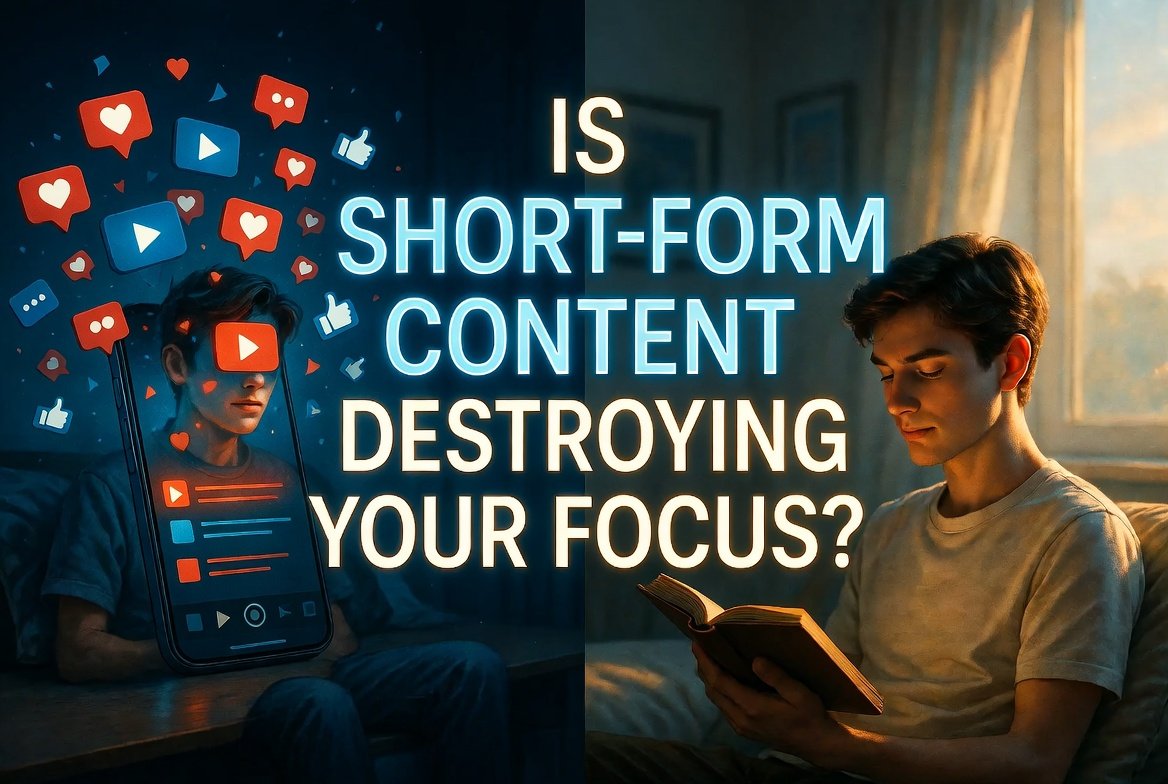
If you’ve noticed that your ability to focus isn’t what it used to be, you’re not imagining it. I’ve had that same realization myself. There was a time when I could sit with a task for hours, completely immersed, but somewhere along the way, that depth of focus started slipping. At first, I blamed stress, workload, or even lack of discipline. But over time, I began to notice a pattern—my habits around short-form content had changed significantly.
Short-form videos, quick posts, and rapid-fire content had become part of my daily routine. What seemed harmless at first slowly began to reshape how I engaged with information. This is the reality of the short form content attention span shift. It’s not dramatic or obvious at first, but it gradually rewires how we think, how we consume, and how long we can stay present with anything.
Table of Contents
What Short-Form Content Really Does to Your Mind
Short-form content is designed for speed and immediacy. Everything about it—from the quick cuts to the strong hooks—is optimized to grab your attention instantly. When you consume this kind of content regularly, your brain begins to adapt to that pace.
From my experience, this adaptation doesn’t feel like a problem at first. In fact, it feels efficient. You get information quickly, you’re entertained in seconds, and there’s always something new to see. But over time, your brain starts expecting that same level of stimulation everywhere else. When something slower comes along, like reading a book or working on a complex task, it begins to feel unusually difficult.
What’s happening here is subtle but powerful. Your mind is being trained to prioritize speed over depth, and that shift changes how you process everything else in your life.
The Role of Dopamine in Short-Form Consumption
One of the biggest turning points in my understanding came when I started paying attention to how I felt after scrolling. It wasn’t just distraction—it was a kind of mental restlessness. Even after stopping, my mind still wanted more stimulation.
This is largely driven by dopamine. Every time you scroll and encounter something interesting, funny, or surprising, your brain releases a small amount of dopamine. The more frequently this happens, the more your brain begins to crave that cycle.
Over time, your baseline changes. Activities that once felt engaging, like studying or writing, no longer provide the same level of satisfaction. It’s not that they’ve become less valuable—it’s that your brain has been conditioned to expect faster rewards. This is where the real impact on short form content attention span begins to show.
How Your Attention Span Becomes Fragmented
One of the most noticeable changes I experienced was how fragmented my attention became. Instead of staying focused on one thing, my mind would jump from one thought to another. Even when I tried to concentrate, there was this constant urge to check my phone or switch tasks.
Short-form content encourages this kind of mental behavior. It teaches your brain to move quickly, to process briefly, and then to move on again. Over time, this pattern becomes your default mode of thinking.
This fragmentation doesn’t just affect entertainment—it spills into your work, your conversations, and even your rest. You may find yourself unable to stay present, even in moments that matter.
The Impact on Deep Thinking and Productivity
As I became more aware of these changes, I started to see how they were affecting my work. Tasks that required deep thinking felt more challenging than before. It wasn’t a lack of ability—it was a lack of sustained focus.
Deep thinking requires time and mental stability. It asks you to sit with an idea, explore it, and develop it fully. Short-form content, on the other hand, conditions your brain to move quickly and avoid staying in one place for too long.
This mismatch creates friction. You want to focus, but your brain resists. You start a task, but your attention drifts. Over time, this can lead to lower productivity and a sense of frustration that’s hard to explain.
Why This Shift Matters in Everyday Life
It’s easy to think of attention span as just a productivity issue, but it goes much deeper than that. Your ability to focus affects how you learn, how you connect with others, and how you experience life.
When your attention is constantly divided, even simple moments can feel less meaningful. Conversations become shorter, tasks feel more draining, and your overall sense of clarity begins to fade.
From my own journey, I realized that reclaiming my attention wasn’t just about getting more done—it was about feeling more present and in control of my time.
Recognizing the Signs in Yourself
The effects of short-form content on attention don’t always show up in obvious ways. Sometimes, they appear as small changes in behavior. You might notice that you reach for your phone more often, even without a clear reason. You might find it harder to sit through longer videos or read without distraction.
There’s also a subtle impatience that can develop. When something doesn’t deliver immediate value, you feel the urge to move on quickly. Over time, this becomes a habit that shapes how you approach everything.
Recognizing these patterns is the first step toward change. Once you become aware of them, you can begin to make more intentional choices.
Rebuilding Your Attention Span Through Intentional Habits
The good news is that your attention span is not permanently damaged. Just as it adapts to short-form content, it can also adapt back to deeper, more focused engagement.
In my experience, the key is not to eliminate technology entirely, but to use it more intentionally. When I started reducing my exposure to constant scrolling, I noticed a gradual shift. My mind felt calmer, and my ability to focus began to return.
Reintroducing slower forms of content played a big role in this process. Reading, watching longer videos, and engaging in single-task activities helped retrain my brain. At first, it felt uncomfortable, but over time, it became natural again.
The most important change, however, was learning to sit with moments of stillness. Instead of immediately reaching for my phone, I allowed myself to pause. That simple shift made a significant difference in how my mind operated.
A Digital Minimalist Approach to Short-Form Content
As a digital minimalist, I don’t believe in completely rejecting modern technology. Short-form content has its place, and it can be useful when consumed mindfully. The problem arises when it becomes automatic and excessive.
The goal is to create a healthier relationship with your devices. This means being aware of how you use them and making deliberate choices about when and why you engage with certain types of content.
For me, this involved setting boundaries and being more selective about what I consumed. Instead of endless scrolling, I focused on content that added value. This shift didn’t happen overnight, but it gradually changed how I experienced both technology and my own attention.
Conclusion: Protecting Your Attention in a Fast-Paced World
Short-form content is not inherently harmful, but its impact on attention is real. The more you consume it without awareness, the more it shapes how your mind works.
Your attention span is one of your most valuable resources. It determines how deeply you can think, how effectively you can work, and how fully you can experience life.
From my own experience, reclaiming that attention is possible. It doesn’t require drastic changes, but it does require intention. By becoming more aware of your habits and making small adjustments, you can begin to rebuild your focus and regain control over your time.
In a world designed to capture your attention, choosing where you place it is one of the most powerful decisions you can make.
FAQ: Short Form Content Attention Span
What is short form content attention span?
Short form content attention span refers to how frequent exposure to short, fast-paced content affects your ability to focus on longer tasks or engage deeply with information over time.
Does short-form content reduce attention span?
Excessive consumption can reduce your ability to concentrate by training your brain to expect quick rewards and constant stimulation, making slower activities feel less engaging.
Can attention span be improved after excessive scrolling?
Yes, attention span can improve with intentional habits such as reducing short-form content consumption, engaging in deep work, and gradually reintroducing longer forms of content.
Why does short-form content feel so addictive?
It feels addictive because it delivers quick bursts of dopamine through constant novelty and stimulation, which encourages repeated consumption.
How can I balance short-form content and productivity?
Balancing both involves setting limits, being intentional about when you consume short-form content, and prioritizing activities that require deeper focus during your most productive hours.
Further Reading
Here are credible academic and research-backed resources you can link to:
- Impact of Short-Form Video Consumption on Students’ Attention Span
👉 This recent academic study shows that heavy short-video use is linked to weaker sustained attention and increased off-task behavior. - Influence of TikTok Short-Form Videos on Attention and Study Habits
👉 Research found that frequent short-form video users reported reduced concentration and poorer study habits. - The Attention Span Economy: How Short-Form Media Shapes Behavior
👉 This paper explains how modern platforms compress attention into seconds and reshape how we consume information.