Deep Work vs Doomscrolling: Two Versions of You Competing for Attention
There’s a strange tension I’ve noticed in my own life. Some days, I feel mentally sharp—able to think clearly, focus deeply, and finish meaningful work. Other days, I feel scattered, restless, and constantly pulled toward my phone without even realizing it.
What changed between those two versions of me wasn’t intelligence or motivation. It was attention.
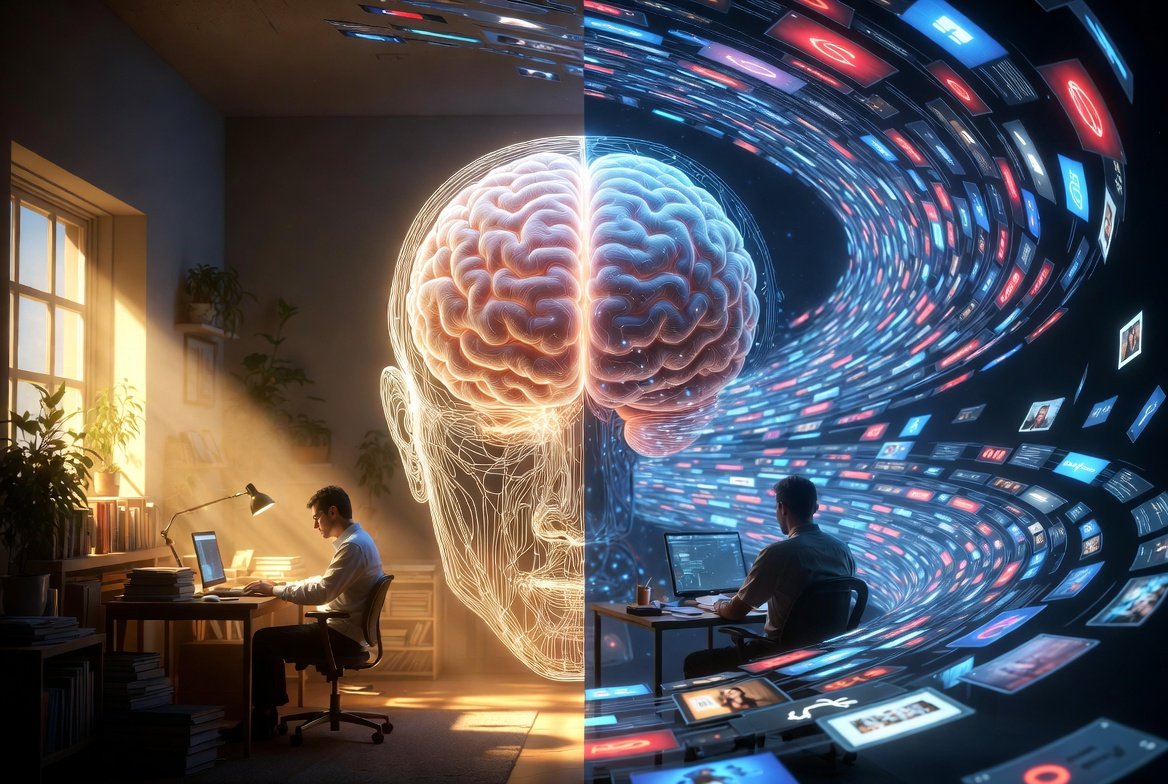
This is where the battle of deep work vs scrolling becomes very real. It’s not just a productivity concept—it’s a daily struggle happening quietly inside your brain every time you choose between focus and distraction.
And the most interesting part? Most of us don’t even notice we’re choosing.
The Reality of Deep Work: When Your Brain Is Fully Present
Deep work is one of those states you only fully appreciate when you’ve experienced its opposite. I didn’t understand it properly until I noticed how rare uninterrupted focus had become in my own routine.
Deep work is not just “working hard.” It’s a mental state where your attention is fully locked in. There are no interruptions, no switching between apps, no background noise pulling you away. Just you and a single task.
When I’m in that state, time behaves differently. A 30-minute session can feel like 10 minutes, yet the amount of progress made is significantly higher than hours of distracted effort.
What makes deep work powerful is not just productivity—it’s clarity. Your thoughts become structured, your decisions more intentional, and your output more meaningful. It feels like your brain is finally operating at its full capacity.
But that state is fragile, and increasingly rare.
Doomscrolling: The Silent Attention Hijacker
Doomscrolling doesn’t always feel harmful in the moment. In fact, it often feels like a break. A few minutes of “just checking” turns into extended scrolling sessions that seem harmless until you try to stop.
From my own experience, doomscrolling rarely starts with intention. It usually begins with boredom, stress, or a quick urge to disconnect. But instead of resting the mind, it keeps it in a constant state of stimulation.
The problem is not just the content—it’s the endless flow of it. There is no natural stopping point, no closure, no moment where your brain feels satisfied enough to pause.
That’s where the damage begins. Your attention is never fully resting. It is constantly being reset, interrupted, and redirected. Over time, this creates a mental environment where sustained focus feels uncomfortable.
What Constant Distraction Is Actually Doing to Your Brain
When I started paying attention to my own patterns, I noticed something subtle but important: my brain had started avoiding silence and depth.
Constant distraction changes how your brain processes effort. Deep work requires resistance—it asks you to stay with something even when it’s not immediately rewarding. Doomscrolling removes that resistance entirely.
Over time, your brain begins to prefer the path of least effort. Instead of staying with a difficult task, it seeks easier stimulation. Instead of thinking deeply, it jumps to something new.
This shift doesn’t just affect productivity. It affects how you think. Your thoughts become shorter. Your patience becomes thinner. Your ability to sit with complexity starts to fade.
It’s not dramatic. It’s gradual. And that’s what makes it dangerous.
The Attention Split: Why Focus Feels Harder Than It Used to
One of the clearest effects of the deep work vs scrolling imbalance is the feeling of mental fragmentation.
You sit down to work, but your attention keeps drifting. You open a tab, then another. You check your phone without thinking. Even when you’re “working,” part of your mind is still expecting interruption.
I used to think this was multitasking. But it’s not. It’s divided attention. And divided attention is exhausting.
What’s happening underneath is that your brain is constantly switching contexts. Each switch carries a cognitive cost. Over time, this creates mental fatigue that feels like burnout, even when you haven’t done much deep work at all.
Why Deep Work Feels Difficult After Scrolling
There’s a noticeable shift that happens after even a short scrolling session. When I try to return to focused work afterward, it feels heavier than it should.
This isn’t imagination. It’s adaptation.
Short-form content trains your brain to expect rapid rewards and constant novelty. Deep work does the opposite. It requires delayed gratification. You don’t get instant satisfaction—you get it after sustained effort.
When your brain has been conditioned by scrolling, that delay feels uncomfortable. So you naturally resist it.
This is why even simple tasks can feel harder after extended phone use. It’s not the task—it’s the transition your brain is struggling with.
The Emotional Side: Why Distraction Feels Easier Than Focus
There’s also an emotional layer to this. Scrolling often feels comforting. It doesn’t demand anything from you. You don’t have to think deeply or make decisions. You just consume.
Deep work, on the other hand, demands presence. It forces you to confront uncertainty, complexity, and effort.
I’ve noticed that when I’m mentally tired or overwhelmed, I gravitate toward scrolling not because I want information, but because I want escape. It becomes a form of emotional avoidance.
The problem is that the escape is temporary, but the fragmentation it creates lingers much longer.
Rebuilding Your Ability to Focus Deeply
Recovering from constant distraction isn’t about willpower alone. It’s about retraining your environment and your habits.
In my experience, the most effective shift came from creating small, protected blocks of focus time. Not long hours—just short, intentional periods where I removed all distractions and committed to a single task.
At first, it felt uncomfortable. My mind kept reaching for stimulation. But over time, something changed. The discomfort reduced, and focus started to feel more natural again.
Another important change was reducing the “frictionless access” to scrolling. When distraction becomes slightly harder to access, your brain has more space to choose differently.
These changes might seem small, but they rebuild your attention layer by layer.
A Digital Minimalist Perspective on Focus
From a digital minimalist perspective, the issue is not technology itself, but how effortlessly it fragments attention.
The goal is not to reject digital tools, but to design your relationship with them intentionally. When I stopped treating my phone as a default response to boredom, I started reclaiming pockets of mental clarity throughout my day.
Deep work thrives in environments where attention is protected. Doomscrolling thrives in environments where attention is unguarded.
The difference between the two is not intelligence or discipline—it is structure.
Conclusion: Choosing Which Version of You Shows Up
At the end of the day, deep work vs scrolling is not just a productivity debate. It’s a reflection of how you spend your attention, and ultimately, how you shape your thinking.
One path strengthens your ability to focus, create, and think deeply. The other fragments it slowly over time.
What I’ve learned through my own experience is that you don’t have to eliminate distraction completely to regain control. You just have to become more aware of when you’re slipping into it—and gently redirect yourself back to depth.
Because the quality of your life is often shaped by one simple thing: how long you can stay with a single thought without running away from it.
❓ FAQ: Deep Work vs Scrolling
What is deep work vs scrolling?
Deep work vs scrolling refers to the contrast between focused, uninterrupted cognitive work and passive, repetitive consumption of short-form digital content.
Why does scrolling make it harder to focus?
Scrolling conditions your brain to expect fast rewards and constant novelty, which makes slower, effort-based tasks feel more difficult to engage with.
Can doomscrolling affect productivity?
Yes, doomscrolling reduces productivity by fragmenting attention, increasing mental fatigue, and making it harder to sustain focus on meaningful tasks.
How do I switch from scrolling to deep work?
You can transition by creating distraction-free time blocks, reducing easy access to social media, and gradually increasing periods of focused work.
Is deep work a skill you can rebuild?
Yes, deep work is a trainable skill. With consistent practice and reduced distractions, your brain can relearn sustained focus over time.
Why does deep work feel uncomfortable at first?
It feels uncomfortable because your brain has adapted to quick stimulation, and deep work requires delayed gratification and sustained attention.