close
Tech-Life Balance

Does Scrolling Make You Tired? Neuroscience Explains the Mental Crash

does scrolling make you tired

Most evenings, we tell ourselves we’ll check our phones for a minute while the kettle boils or while we rest our eyes after a long workday. Twenty minutes later, the room is darker, our shoulders are slumped, and we feel oddly drained despite barely moving. This pattern has become familiar for many remote workers and students in 2025 and 2026, when our phones double as offices, newsstands, and social spaces.

The tiredness that follows scrolling doesn’t feel like muscle fatigue. It’s more subtle, heavier, and harder to explain.

That experience raises a simple but important question people keep asking in different ways: does scrolling make you tired, or are we just imagining it?

Does scrolling actually make you tired?

To answer this honestly, we need to separate physical exhaustion from mental fatigue. Scrolling does not burn many calories or strain the body the way physical work does. Yet the tiredness after a long scroll session is real and increasingly well understood. Many of us notice it most on days when our work already demands sustained attention. A short scroll break feels harmless, but it often leaves us less focused than before.

From a neuroscience perspective, scrolling creates cognitive load rather than physical strain. Our brains are processing constant streams of information, making micro-decisions every second: what to read, what to ignore, whether to like, reply, or swipe away. Over time, this taxes the same attention systems we rely on for work, learning, and emotional regulation.

This is why the tiredness feels different from being sleepy. We may not want to lie down, but motivation drops, patience thins, and simple tasks start to feel harder than they should.

Mental fatigue vs physical tiredness

Understanding the difference between these two states helps explain why scrolling feels draining even when the body is still. Physical tiredness usually follows muscle use, limited energy stores, or lack of sleep. Mental fatigue shows up differently, through reduced concentration, slower thinking, irritability, and a desire to disengage.

Many of us notice it when we reread the same sentence on our laptop after scrolling or postpone small decisions that normally feel easy. Mental fatigue is especially common in digital environments because the brain evolved to focus deeply on fewer stimuli, not to skim hundreds of unrelated cues in quick succession.

What happens in the brain when we scroll endlessly?

The brain is not passive while we scroll. It is actively predicting, evaluating, and updating information at high speed. Each swipe introduces something new: a headline, a face, a joke, a problem, or a reward signal. This constant novelty is stimulating at first, but it comes at a cost.

Neuroscience research shows that sustained attention and frequent attention switching draw from the same limited mental resources. When those resources are depleted, the brain shifts into a low-energy mode that feels like mental exhaustion rather than physical tiredness.

Person lying on couch scrolling phone while daylight fades

Dopamine, novelty, and the illusion of rest

Scrolling often feels relaxing because it is easy and entertaining. From the brain’s perspective, however, the experience is more activating than restorative. Scrolling heavily involves dopamine, a neurotransmitter linked to motivation and reward anticipation. Each new post or notification carries the possibility of something interesting, funny, or socially rewarding.

As a result, the brain stays in a state of anticipation rather than recovery. Many of us recognize this at night, when scrolling before bed keeps the mind alert instead of winding down. When we finally stop, we may feel wired yet mentally flat, a sign that stimulation continued without true rest.

This dopamine-driven loop doesn’t cause exhaustion in the same way physical labor does. Instead, it leads to a subtle motivational drop once the stimulation ends.

Attention switching and cognitive overload

Another major contributor to scrolling fatigue is attention switching. Scrolling fragments attention into seconds-long bursts. One moment we’re reading about global news, the next we’re watching a short video, then responding to a message. Each switch carries a small cognitive cost.

Over time, these costs accumulate. The brain spends energy constantly reorienting itself. In remote work environments, where deep focus is already challenged by notifications and multitasking, scrolling accelerates mental depletion. Many of us notice that even a short scroll break between tasks can make it harder to regain focus than stepping away briefly or sitting quietly.

Why scrolling feels different from reading a book or watching a film

Not all screen time affects the brain the same way. The tiredness linked to scrolling is less about screens and more about interaction patterns. Reading a book or watching a film usually involves sustained attention and a coherent narrative. Scrolling delivers fragmented content with no natural endpoint.

Because there is always another post waiting, the brain never fully settles. Instead, it remains in a semi-alert state, constantly deciding whether to continue or move on. This unresolved loop consumes mental energy and helps explain why time passes quickly while focus and clarity quietly drain.

Real-life smartphone patterns that amplify fatigue

In daily life, scrolling fatigue tends to appear at predictable moments. Late evenings are a common trigger because mental resources are already low. Commute scrolling, bedtime scrolling, and stress-driven scrolling during work breaks all stack on top of existing cognitive demands.

We also see how modern platform design encourages extended use through infinite feeds, autoplay, and personalized recommendations. These features are not inherently harmful, but they reduce natural stopping cues, making it easier to scroll beyond the point where the brain would normally disengage.

Scrolling vs truly restorative activities

To better understand the difference, it helps to compare scrolling with activities that genuinely restore mental energy. The distinction is not about discipline or productivity, but about how the brain recovers.

Before reviewing the comparison, it’s important to note that restorative activities usually lower cognitive demand rather than replace one form of stimulation with another.

Activity TypeCognitive DemandDopamine PatternEffect After 20 Minutes
Social media scrollingHigh, fragmentedConstant anticipationMental fatigue, reduced focus
Short walk outdoorsLow, steadyMild and stableImproved clarity and mood
Listening to calm musicLowMinimal spikesMental relaxation
Reading a physical bookModerate, sustainedGentle engagementCalm focus
Mindful breathingVery lowNeutralMental reset

This comparison reflects what many of us observe in our routines. When we replace a scroll break with a walk, quiet rest, or low-stimulation activity, we often return clearer rather than more drained.

Why the mental crash feels sudden

One of the most confusing aspects of scrolling fatigue is how suddenly it appears. For a while, scrolling feels effortless and even soothing. Then motivation drops sharply. This happens because the brain compensates until it reaches a limit. Once attention resources fall below a certain threshold, the contrast becomes obvious.

This is why we often say, “I don’t know why, but I’m suddenly exhausted.” The fatigue has been building quietly the entire time.

How scrolling tiredness differs from healthy relaxation

Not all rest restores us in the same way, even if it feels pleasant in the moment. Healthy relaxation allows the brain to downshift, reducing cognitive demand and giving attention systems a chance to recover. Scrolling, by contrast, often keeps those systems lightly engaged, even when the content feels casual.

When we relax in a restorative way, such as sitting quietly, stretching, or listening to music, there is a sense of mental spaciousness afterward. With scrolling, the after-effect is often the opposite: a subtle fog, reduced motivation, or difficulty transitioning to the next task. The key difference lies in whether the brain is allowed to settle, or whether it stays in a low-level state of alertness.

Situations where scrolling feels energizing vs draining

Scrolling is not always exhausting. Context matters. We often feel energized when scrolling briefly with a clear purpose, such as replying to a message, checking a specific update, or seeking inspiration during a creative block. In these cases, the interaction is short, intentional, and bounded.

Scrolling becomes draining when it is open-ended and driven by habit rather than need. Late-night scrolling, stress scrolling between tasks, or scrolling when we are already mentally depleted tends to amplify fatigue. The same app can feel stimulating at midday and exhausting at night, depending on our cognitive reserves and emotional state.

Gentle ways to reduce scrolling fatigue without deleting apps

Reducing scrolling fatigue does not require extreme measures or abandoning technology. Small, realistic adjustments often make the biggest difference, especially for those of us who rely on smartphones for work and connection.

Before making changes, it helps to recognize that the goal is not to scroll less out of guilt, but to scroll in ways that respect how the brain actually recovers.

Some practical approaches include:

  • Setting soft boundaries, such as scrolling only after a specific task is finished.
  • Switching from infinite feeds to finite content, like saved articles or newsletters.
  • Creating short “buffer moments” after scrolling, such as standing up, stretching, or looking outside.
  • Lowering stimulation by muting nonessential notifications during focus-heavy hours.
  • Replacing some scroll breaks with low-effort alternatives like music, tea, or a brief walk.

These changes work because they reduce constant novelty and give attention systems clearer start and stop points.

Common myths about “unwinding” with your phone

Many of us grew up believing that unwinding simply means doing something easy and entertaining. In a digital world, this belief often translates into reaching for the phone whenever we feel tired or stressed. Neuroscience suggests this assumption is incomplete.

One common myth is that passive scrolling rests the brain. In reality, the brain is still working, just in a different mode. Another myth is that more content equals more relaxation. Often, the opposite is true. The more fragmented the input, the harder it is for the brain to truly disengage.

A third misconception is that feeling bored is bad. Mild boredom is actually a natural gateway to mental recovery, creativity, and emotional regulation. Filling every pause with scrolling removes that opportunity.

Relearning what rest feels like in a digital world

One of the challenges of modern phone use is that it can blur our internal signals. We may interpret mental fatigue as a need for stimulation rather than rest. Over time, this can create a loop where we scroll to cope with tiredness, only to feel more depleted afterward.

By paying attention to how we feel after different types of breaks, we begin to recalibrate. Many of us discover that even short periods of low-stimulation rest feel more nourishing than extended scrolling. This awareness, rather than strict rules, is what supports healthier digital habits over the long term.

Conclusion

Scrolling does not make us tired because we are weak, distracted, or lacking discipline. It makes us tired because the human brain was not designed for endless novelty, rapid attention switching, and constant low-level decision-making. In moderation and context, scrolling can be enjoyable and even energizing. When it replaces true mental rest, it quietly drains our cognitive reserves.

The solution is not to quit our phones or reject modern life. It is to understand how our brains respond to digital patterns and to make gentle adjustments that support recovery. When we align our phone habits with how attention actually works, tiredness becomes a signal we can respond to, not a mystery we have to fight.

FAQ Section

Does scrolling make you tired even if you enjoy it?

Yes, enjoyment and fatigue can coexist. Scrolling often feels pleasant because it engages reward systems in the brain. At the same time, it places ongoing demands on attention and decision-making. This combination can lead to mental fatigue afterward, even if the experience itself felt enjoyable in the moment.

Why do we feel tired after scrolling but not after watching a movie?

Movies usually involve sustained attention and a single narrative, which allows the brain to settle into a rhythm. Scrolling constantly shifts topics and stimuli, forcing repeated attention resets. These frequent switches consume more cognitive energy, making scrolling more mentally taxing than longer-form media.

Is scrolling before bed worse than scrolling during the day?

For many people, yes. Mental resources are already lower at night, and dopamine-driven novelty can interfere with the brain’s natural wind-down process. Scrolling close to bedtime often delays mental relaxation, making it harder to feel rested even if sleep duration is unchanged.

Can scrolling ever be a healthy way to relax?

It can be, especially when it is intentional and time-limited. Checking updates, connecting socially, or seeking inspiration can feel refreshing when done briefly and earlier in the day. Problems arise when scrolling becomes the default response to fatigue rather than one option among many.

How can we tell when scrolling is becoming draining?

Common signs include feeling foggy afterward, losing motivation, rereading content without interest, or struggling to refocus on tasks. Noticing these patterns without judgment helps us adjust. Fatigue is useful feedback, not a personal failure.

Does reducing scrolling mean we have to be more productive?

No. Reducing scrolling fatigue is about supporting mental well-being, not maximizing output. Rest, reflection, and low-stimulation activities are valuable in their own right. The goal is to feel more balanced and clear, not constantly busy.

Helpful Resources

  1. National Institute of Mental Health (NIMH) – Research on attention, stress, and mental fatigue
  2. American Psychological Association (APA) – Digital media and cognitive well-being studies
  3. Stanford University Neurosciences Institute – Research on attention and cognitive load
  4. National Institutes of Health (NIH) – Neuroscience and brain energy regulation
  5. University College London Cognitive Neuroscience Department – Studies on attention and fatigue

read more
Digital Minimalism

The Psychology of Digital Clutter: Why It Overwhelms Your Brain

Digital clutter is rarely obvious, yet it is deeply felt. Unlike physical mess—papers on a desk or clothes on a chair—digital clutter exists quietly in the background of daily life. From a psychological perspective, digital clutter refers to the accumulation of digital stimuli such as apps, notifications, emails, tabs, and files that continuously compete for attention. Even when screens are off, the brain remains aware of these unfinished digital elements.

Research increasingly links digital clutter and mental health, showing that cluttered digital environments elevate stress, reduce focus, and increase mental fatigue. One reason digital clutter causes stress is that it creates a persistent sense of “unfinished business.” Cognitive psychology shows that the brain is wired to keep track of incomplete tasks, which means unread messages or unused apps continue to occupy mental space long after we stop using our devices.

Psychologists explain this experience using concepts such as cognitive overload, attention fatigue, and mental clutter from technology. The human brain evolved to handle limited information at a time, but modern digital environments expose it to constant inputs. Notifications, updates, and choices accumulate throughout the day, quietly exhausting mental resources.

Understanding the psychology of digital clutter helps explain why even passive screen use can feel draining. This article focuses on why the brain reacts so strongly to digital clutter—before discussing how to manage it—offering insight into the mental mechanisms behind stress, overwhelm, and fatigue.

What Is Digital Clutter (From a Psychological Perspective)

From a psychological standpoint, digital clutter is not defined by how many apps or files you have, but by how many unresolved signals your brain is tracking at once. Physical clutter occupies visible space, while digital clutter occupies cognitive space. A messy room may bother you only when you see it, but a cluttered phone or laptop creates a constant background hum of mental activity.

Unused apps, unread emails, saved screenshots, and open browser tabs all represent potential actions. According to research on attention and memory, the brain treats these as open loops, which demand ongoing mental monitoring. This is why digital clutter often feels heavier than physical mess—it is mentally active, even when invisible.

Notifications are especially disruptive. Studies show that the mere presence of a smartphone reduces available cognitive capacity, even when it is not being used. This means digital clutter does not require interaction to affect focus. Awareness alone is enough.

This constant low-level engagement is what psychologists describe as mental clutter from technology. Over time, it shapes attention patterns, increases stress sensitivity, and reinforces the broader framework of digital clutter psychology, where the mind is rarely fully at rest.

How Digital Clutter Affects the Brain

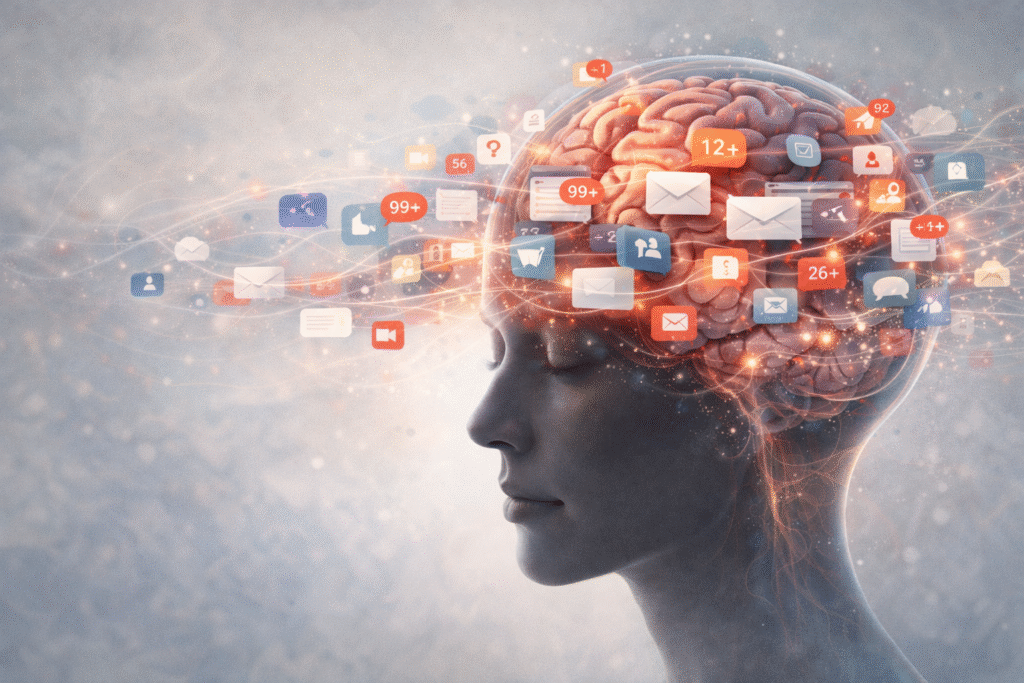
psychology of digital clutter
How Digital Clutter Affets the Brain

Cognitive Overload and Attention Fatigue

One of the most significant effects of digital clutter is cognitive overload from technology. Cognitive Load Theory explains that working memory has limited capacity, and when too much information is presented at once, performance and learning decline.

Digital environments routinely exceed these limits. Each notification, app icon, or unread message represents a choice—respond, ignore, save, or delete. Over time, this leads to attention fatigue, where the brain struggles to sustain focus even during simple tasks. Research on workplace interruptions shows that frequent digital disruptions significantly increase stress and reduce concentration.

This overload also contributes to decision fatigue. When the brain is forced to make too many small decisions, its ability to make thoughtful, higher-quality decisions declines. This explains why people often feel mentally exhausted after scrolling or managing digital tasks, even if no meaningful work was done.

Importantly, this response is neurological, not personal. The brain reacts predictably when pushed beyond its processing limits.

The Stress Response to Information Overload

Beyond attention and focus, digital clutter activates the body’s stress systems. The psychology of information overload shows that when incoming information exceeds processing capacity, individuals experience a loss of control—a major psychological stressor.

Constant notifications and digital demands can elevate cortisol levels, especially when individuals feel unable to keep up. This chronic stress response contributes to anxiety, irritability, and mental exhaustion.

The psychological effects of information overload include reduced working memory, impaired decision-making, and emotional fatigue. Telling yourself to “just ignore it” rarely works because the brain’s alert systems automatically monitor potential demands. Ignoring notifications still requires mental effort—and effort itself consumes cognitive resources.

As a result, digital clutter creates a feedback loop: the more overwhelmed the brain becomes, the harder it is to process or reduce incoming information.

Why Digital Clutter Feels Harder to Ignore Than Physical Mess

Digital clutter often feels more stressful than physical clutter because it is persistent, invisible, and unpredictable. A messy room can be left behind, but digital clutter follows you everywhere. This constant proximity keeps the brain in a state of partial alertness.

Research shows that anticipating interruptions can be just as cognitively taxing as interruptions themselves. Even silenced notifications create mental tension because the brain expects potential demands.

Another factor is dopamine-driven reinforcement. Notifications and updates are unpredictable rewards, which the brain finds especially stimulating. This makes digital clutter harder to disengage from than physical disorder, which offers no such reward signals.

Ultimately, digital clutter causes stress not because it is dramatic, but because it is constant. It quietly drains focus, elevates stress responses, and reduces the brain’s ability to recover. Over time, this creates a baseline state of digital overwhelm that many people mistake for normal life.

Understanding these psychological mechanisms shifts the conversation away from willpower and toward awareness—laying the foundation for a calmer, more intentional relationship with technology.

The Psychology Behind Digital Hoarding

Digital hoarding is often misunderstood as a storage problem, but psychologically, it is a coping behavior. From a mental health perspective, digital hoarding psychology explains why people accumulate files, emails, screenshots, notes, and apps far beyond what they need—despite feeling stressed by the volume. Unlike physical hoarding, digital hoarding is socially invisible, making it easier to normalize and harder to recognize.

Research on hoarding behavior shows that difficulty discarding items is often linked to anxiety, emotional attachment, and fear of future regret. In digital spaces, this behavior is amplified because storage feels limitless and consequences feel distant. As a result, digital hoarding behavior quietly grows while mental load increases.

Fear of Loss and “What If I Need This?”

One of the strongest drivers of digital hoarding is fear of loss. Emails are kept “just in case,” screenshots are saved “for later,” and files accumulate because deleting them feels irreversible. Psychologically, this reflects loss aversion, a well-documented cognitive bias where the fear of losing something outweighs the perceived benefit of letting it go.

Digital items also carry emotional weight. Photos, old messages, notes, and documents can feel like extensions of memory or identity. Letting go of them may feel like letting go of experiences, proof, or future possibilities. This emotional attachment reinforces digital hoarding psychology, even when the clutter causes stress.

A scarcity mindset further intensifies the problem. Even in an age of abundant storage, the brain still operates as if resources are limited. Thoughts like “What if I need this later?” or “What if I can’t find it again?” trigger anxiety, leading people to keep everything. Ironically, the more we save, the harder it becomes to retrieve anything meaningful—deepening mental clutter rather than reducing it.

Dopamine, Notifications, and Mental Noise

Digital hoarding is not driven by fear alone. Dopamine and notifications play a critical role in keeping clutter alive. Notifications act as intermittent rewards—unpredictable signals that the brain finds especially stimulating. Neuroscience research shows that unpredictable rewards strengthen habit loops more effectively than consistent ones.

Every alert, message, or badge reinforces engagement. Saving content becomes part of the reward cycle: capture now, decide later. Over time, this creates mental noise, where the brain remains in a constant state of low-level stimulation. Even when devices are not actively used, the anticipation of notifications consumes attention.

This persistent stimulation contributes to mental fatigue from screens. Studies show that frequent digital interruptions increase perceived workload and emotional exhaustion, even without an increase in actual tasks. Digital clutter thrives in this environment because the brain is rewarded for accumulation, not resolution.

Digital Clutter and Mental Health

The connection between digital clutter and mental health is becoming increasingly clear. Cluttered digital environments are associated with higher levels of anxiety, stress, and reduced emotional well-being. One reason is that digital clutter continuously signals unfinished tasks, keeping the brain in a state of mild but persistent alertness.

Constant alerts also interfere with rest and recovery. Research links heavy digital engagement—especially before bedtime—to sleep disturbances and increased stress levels. When the brain does not fully disengage, emotional regulation suffers.

Over time, stress caused by technology can reduce attention span, impair focus, and increase irritability. Emotional responses become more reactive, and sustained concentration becomes harder to achieve. This long-term impact explains why digital clutter often feels emotionally draining, not just distracting.

Why Decluttering Feels So Mentally Relieving

The relief people feel after reducing digital clutter is not accidental—it is neurological. Research shows that the brain performs better in environments with fewer competing stimuli. Reducing inputs lowers cognitive load, allowing attention and working memory to function more efficiently.

This is how digital clutter affects the brain: excessive inputs fragment attention, while simplicity restores it. When digital inputs decrease, stress responses calm, decision fatigue lessens, and mental clarity increases. The brain has a natural preference for order and predictability, which explains why clarity often feels calming.

Importantly, the relief comes not from perfection, but from reduced mental demand. Fewer signals mean fewer decisions, fewer interruptions, and more space for intentional thought—making it easier to reduce digital stress without drastic measures.

A Gentle Shift Toward Digital Minimalism

Digital minimalism is not about rejecting technology; it is about realigning it with cognitive and emotional limits. Before action comes mindset. Recognizing that attention is finite—and worth protecting—changes how digital tools are perceived.

Practicing mindful technology use means becoming aware of how digital inputs affect mental state, rather than reacting automatically. Research on mindfulness shows that intentional engagement reduces stress and improves emotional regulation.

When digital input is reduced, mental space expands. Less stimulation allows the brain to recover, reflect, and focus more deeply. This is the essence of digital minimalism: not doing less for the sake of less, but creating conditions where the mind can function with clarity and calm.

Understanding these psychological foundations makes digital change feel less like self-control—and more like self-respect.

Conclusion: Understanding the Psychology Is the First Step

Digital clutter is often treated as a personal failing—something to fix with more discipline, better habits, or stricter rules. But the research tells a different story. The psychology of digital clutter shows that overwhelm is not a lack of willpower; it is the brain reacting exactly as it was designed to react when overloaded with information, choices, and interruptions.

When digital spaces are crowded, the brain remains in a near-constant state of alertness. Unread messages, unused apps, and endless notifications signal unfinished tasks, quietly draining attention and emotional energy. Over time, this creates digital overwhelm, even during moments that are meant to feel restful. Understanding this reframes the problem. It is not about trying harder—it is about working with cognitive limits instead of against them.

Awareness is the most important starting point. Before deleting files or silencing notifications, noticing how digital inputs affect your mental state creates clarity. When people understand why digital clutter feels stressful, guilt softens and intentional change becomes easier. Awareness turns decluttering from a reactive purge into a thoughtful response.

Only after this psychological understanding does practical decluttering make sense. Tools and strategies are most effective when they support mental well-being rather than add new rules to follow. If you’re ready to move from insight to action, you can explore our practical digital decluttering guide, which focuses on reducing mental load—not chasing digital perfection.

Digital clarity does not come from controlling every input. It comes from respecting attention as a limited resource and designing digital spaces that support focus, rest, and emotional balance.

FAQ: Digital Clutter and the Mind

Why does digital clutter cause anxiety?

Digital clutter causes anxiety because it continuously signals unfinished tasks to the brain. Unread notifications, saved files, and open tabs activate attention systems designed to monitor potential demands. This ongoing mental monitoring increases stress and makes it difficult to fully relax, even when nothing urgent is happening.

How does digital clutter affect attention?

Digital clutter fragments attention by creating too many competing signals. Each app, alert, or piece of information requires evaluation, leading to cognitive overload and attention fatigue. Over time, this reduces the brain’s ability to focus deeply and sustain concentration on meaningful tasks.

Is digital clutter worse than physical clutter?

For many people, digital clutter feels more draining than physical clutter because it is invisible and persistent. Physical mess is only mentally demanding when seen, while digital clutter follows you everywhere and remains mentally active through anticipation, notifications, and unresolved tasks.

Can digital minimalism improve mental health?

Yes. Digital minimalism can support mental health by reducing cognitive load and restoring attention. When digital inputs are intentionally limited, stress responses decrease, focus improves, and emotional regulation becomes easier. The goal is not to eliminate technology, but to use it in ways that align with psychological well-being.

Further Reading

  • Zeigarnik Effect and unfinished tasks:
    https://www.verywellmind.com/zeigarnik-effect-2795021
  • Attention and cognitive processes:
    https://www.psychologytoday.com/us/basics/attention
  • The cognitive cost of smartphone presence:
    https://www.journals.uchicago.edu/doi/10.1086/691462
  • Cognitive Load Theory overview:
    https://www.sciencedirect.com/topics/psychology/cognitive-load-theory
  • Workplace interruptions and stress:
    https://dl.acm.org/doi/10.1145/1357054.1357072
  • Decision fatigue and self-control:
    https://www.apa.org/monitor/2012/01/self-control
  • Information overload and loss of control:
    https://www.researchgate.net/publication/228315847
  • Technology, stress, and social media (APA):
    https://www.apa.org/news/press/releases/stress/2017/technology-social-media
  • Anticipation of interruptions and attention:
    https://www.microsoft.com/en-us/research/publication/focused-aroused-but-so-distractible
  • Dopamine, habit formation, and digital design:
    https://www.nirandfar.com/irresistible/
  • Hoarding behavior and mental health research:
    https://www.ncbi.nlm.nih.gov/pmc/articles/PMC3181961/
  • Loss aversion (cognitive bias):
    https://thedecisionlab.com/biases/loss-aversion
  • Dopamine, rewards, and habit loops:
    https://www.ncbi.nlm.nih.gov/pmc/articles/PMC4444603/
  • Digital interruptions and emotional exhaustion:
    https://www.frontiersin.org/articles/10.3389/fpsyg.2018.02694/full
  • Digital use, sleep, and stress:
    https://bmcpublichealth.biomedcentral.com/articles/10.1186/1471-2458-11-66
  • Mindfulness and mental health (APA):
    https://www.apa.org/monitor/2012/07-08/mindfulness
read more